Innovation & Tinkering Lab

Where students stop asking "how does it work?" and start asking "what can I make?"

A STEM maker space built to the Atal Tinkering Lab framework. Students design and build solutions to problems in their own village, with kits, a design-thinking curriculum, teachers trained as mentors, and support that keeps the lab in use.

● design thinking · 5 stepsexample project

Problem: the school water tank overflows every morning

1. Empathise: Talk to the people who live with the problem

Students ask the school caretaker how the tank is filled each morning, and watch where the water goes.

2. Define: Say exactly what the problem is

The tank overflows because nobody can tell from the ground when it is full.

3. Ideate: Think of many ways to solve it

A float switch? A buzzer? A light the caretaker can see from the gate? Each team sketches at least ten ideas.

4. Prototype: Build a rough version fast

A water-level sensor and a buzzer on a microcontroller, tested first in a cardboard model of the tank.

5. Test: Try it for real, then improve it

The alarm runs on the real tank for a week. Students count the litres saved and fix what didn't work.

Every project starts with a real needRobotics · electronics · IoT
~10,000Atal Tinkering Labs already in Indian schoolsPIB ↗
50,000more planned in government schools over five yearsPIB ↗
64% → 43%share of enrolled students taking part in ATLs, first year to 2022–23Business Standard ↗

What is an Innovation & Tinkering Lab?

Anylan Foundation's Innovation & Tinkering Lab is a STEM maker space for government schools in Madhya Pradesh and Maharashtra, built to the Atal Tinkering Lab framework. Students use robotics, electronics, IoT and fabrication tools to design and build solutions to real local problems. Each lab comes with kits, a design-thinking curriculum, teacher training and ongoing support, funded through CSR.

Who it's for
Government schools, Grades 6–12
Where
Madhya Pradesh and Maharashtra; also Chhattisgarh, Gujarat, Rajasthan and Uttar Pradesh
Framework
Atal Tinkering Lab compatible
Funding
CSR, Schedule VII (ii) education
What's included

Four zones in one tinkering lab

More labs are coming to government schools. Keeping them in use is the hard part, so every lab comes with the people and plan to run it, not just the equipment.

Robotics

Ultima kits to build and program machines, with block coding in Hindi, Marathi or English.

Electronics & IoT

Sensors, circuits and connected devices that measure and respond to the world.

Fabrication

A 3D printer and hand tools to turn a sketch into a physical prototype. Schools can add a Unimat makerspace: child-safe machines for woodturning, sawing, sanding and drilling, with metalworking and CNC sets for older students.

Design

Challenge assignments in our curriculum take students through the design-thinking process: empathise, define, ideate, prototype, test.

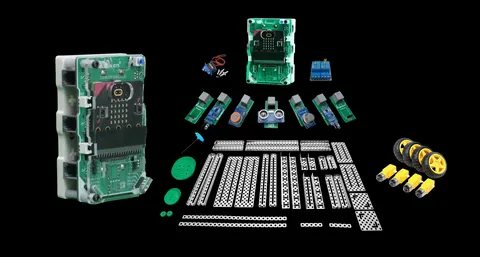
Ultima Kit laid out: the controller in its case, sensor modules, motors, wheels and chassis plates
RoboticsUltima KitThe controller, sensors, motors, wheels and chassis plates for building and coding machines.
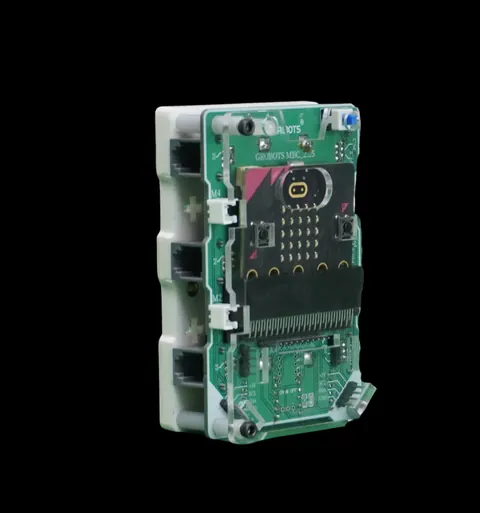
Ultima controller in a clear case, with an LED grid, buttons and a small display
The brainUltima controllerA programmable controller with a small display, in a sturdy clear case.
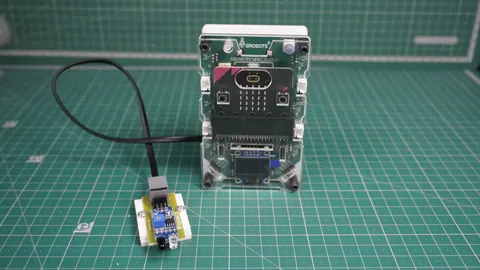
An Ultima controller connected to a sensor module with one plug-in cable
ElectronicsPlug-in sensorsSensors connect with a single cable, so first builds need no wiring.
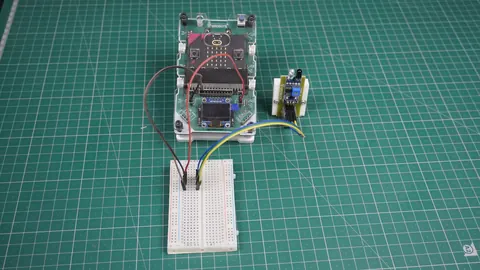
An Ultima controller wired to a sensor through a breadboard with jumper wires
Electronics & IoTBreadboard circuitsAs skills grow, students wire their own circuits on a breadboard.
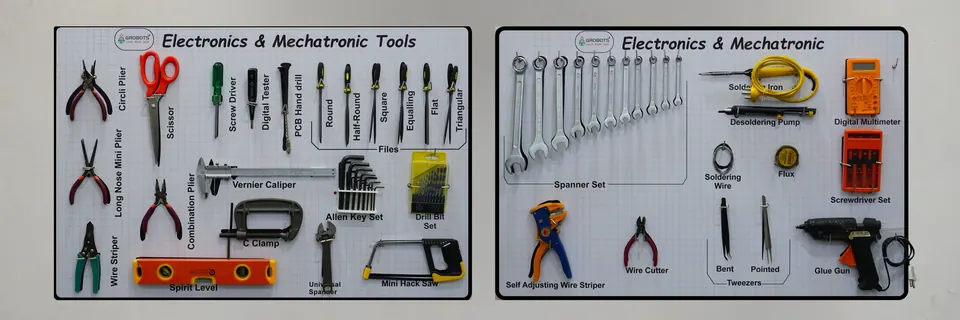
Two tool wall boards with electronics and mechatronics hand tools: pliers, screwdrivers, spanners, a soldering iron and a multimeter
Tool wall: electronics and mechatronicsEvery hand tool has its own outlined place, so the lab stays organised and nothing goes missing.

Every tinkering lab comes with Ultima kits. Kits and tool walls by Grobots, the robotics brand of our implementation partner. Product photos.

Teachers as mentorsTraining that turns teachers into innovation coaches, not lab caretakers.
A path to competitionsFrom school exhibition to district and national platforms.
Measured outcomesProject portfolios, lab usage and participation in every report. How we measure
For schools that already have an ATL

Atal Tinkering Lab support: get an existing lab working again

Many tinkering labs have the equipment but not the routine. A CSR partner can fund the support that brings a quiet lab back into weekly use, often for much less than a new lab. One on-site resource person looks after up to five nearby schools.

Indicative cost₹55,000–60,000 a monthfor one on-site resource person covering up to 5 schools, about ₹11,000–12,000 per school a month, depending on location. The cost covers the resource person only.
Revive an ATL →
  1. 01
    Lab checkWhat works, what's missing and why the lab isn't being used.
  2. 02
    An on-site resource personA trained resource person, shared by up to five nearby schools, runs sessions with the ATL in-charge.
  3. 03
    Teacher trainingThe ATL in-charge and other teachers trained to run sessions with confidence.
  4. 04
    Challenge assignmentsCurriculum challenges that train students in the design-thinking process, from a real problem to a working prototype.
  5. 05
    Project mentoring and repairsHelp for student projects, and broken equipment fixed or replaced.
  6. 06
    A usage reportSessions, participation and projects, reported to the funder every term.
Partner record

What students have built in tinkering labs

These results come from Atal Tinkering Labs set up by our implementation partner in government schools. They show what a lab that stays in use makes possible.

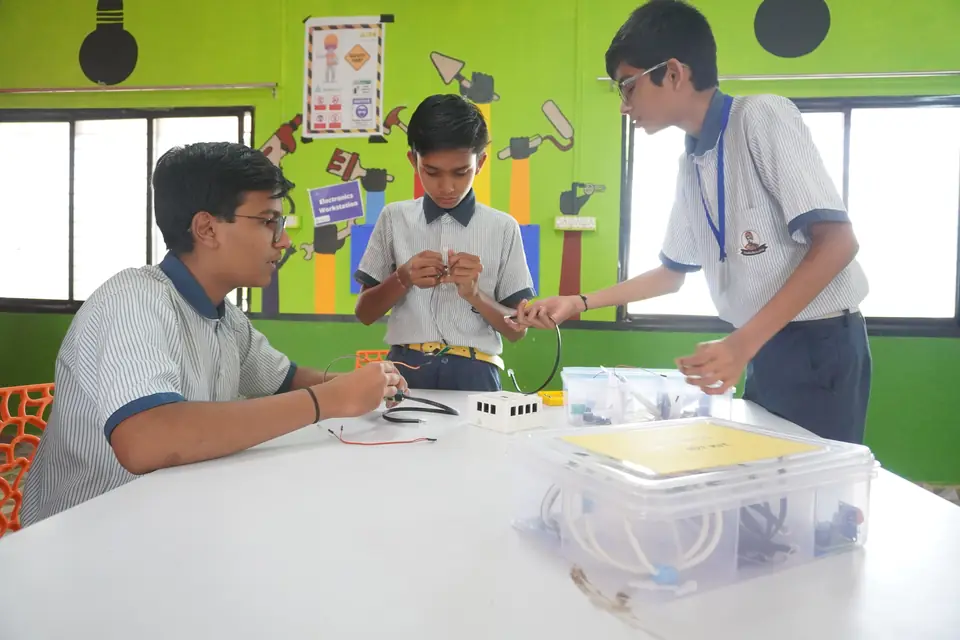
Three students wiring a circuit, kit box in front of them
Partner record

A patent, earned in a school lab

Government school students in Bilaspur, Chhattisgarh, guided by their ATL in-charge Dr. Dhananjay Pandey, built "Atal Krishi Mitra": one machine that ploughs, sows, cuts, sprays and irrigates at the same time. It was among the Top 50 projects of the ATL Marathon 2018, was shown at Rashtrapati Bhavan, and was granted Indian Patent No. 500218 in 2024.

Partner record

An electric car, built by students

Government school students in Ashta, Madhya Pradesh designed and built a working electric car in their Atal Tinkering Lab in 2021, from motor and suspension to steering and wiring.

Partner record · Video: the electric car project itself, a short silent highlight. Photo: an Atal Tinkering Lab set up by our implementation partner in a client school; it shows lab activity, not the patent project itself. About our implementation partner →

Plan a tinkering lab

Tell us how many schools and where.

For a new lab or an existing ATL. We'll send a quote and offer you a visit to a working lab.

Send us your enquiry

Message us on WhatsApp or email us with your organisation, the number of schools and the region you have in mind. We'll reply with a quote.

Or call Sapan Jain on +91 70242 30852.

Questions

Tinkering labs and ATLs: common questions

What is an Atal Tinkering Lab?

An Atal Tinkering Lab (ATL) is a school maker space set up under the Atal Innovation Mission of NITI Aayog, where students from Class 6 to Class 12 build projects with electronics, robotics, sensors and 3D printing. Anylan Foundation's Innovation & Tinkering Lab is built to the same framework.

Can CSR funds be used to set up a tinkering lab in a government school?

Yes. Promoting education is listed under Schedule VII (ii) of the Companies Act, 2013. Anylan Foundation is registered with the Ministry of Corporate Affairs to implement CSR projects (CSR-1: CSR00096762).

Can you support a school that already has an Atal Tinkering Lab?

Yes. An on-site resource person, shared by up to five nearby schools, runs sessions with the ATL in-charge, trains teachers, and uses our curriculum's challenge assignments to teach design thinking. We also handle repairs and report lab usage to the funder.

How much does ATL support cost through CSR?

An on-site resource person covering up to five nearby schools costs ₹55,000–60,000 a month, depending on location. That is about ₹11,000–12,000 per school a month. The cost covers the resource person only.

How is the Innovation & Tinkering Lab different from the Robotics & AI Lab?

The Robotics & AI Lab follows a grade-wise curriculum from Grade 3 to Grade 9. The Innovation & Tinkering Lab is an open maker space where students design and build solutions to real problems around them.

Which grades is the Innovation & Tinkering Lab for?

Grades 6 to 12, the same classes Atal Tinkering Labs serve.

What do students make in a tinkering lab?

Working solutions to real problems, such as water-saving alarms, farm sensors and safety devices, using robotics, electronics, IoT and design thinking. Labs supported by our implementation partner have produced a student patent and a student-built electric car.